<?xml version="1.0" encoding="utf-8"?><feed xmlns="http://www.w3.org/2005/Atom" ><generator uri="https://jekyllrb.com/" version="3.10.0">Jekyll</generator><link href="https://verrynatalia.github.io/feed.xml" rel="self" type="application/atom+xml" /><link href="https://verrynatalia.github.io/" rel="alternate" type="text/html" /><updated>2026-03-29T01:40:27+00:00</updated><id>https://verrynatalia.github.io/feed.xml</id><title type="html">NATALIA ECHEVERRY</title><subtitle>Instructional Designer</subtitle><author><name>Natalia Echeverry</name></author><entry><title type="html"></title><link href="https://verrynatalia.github.io/2025-08-08-CS-students-using-AI-tools/" rel="alternate" type="text/html" title="" /><published>2026-03-29T01:40:27+00:00</published><updated>2026-03-29T01:40:27+00:00</updated><id>https://verrynatalia.github.io/2025-08-08-CS-students-using-AI-tools</id><content type="html" xml:base="https://verrynatalia.github.io/2025-08-08-CS-students-using-AI-tools/"><![CDATA[<p><a href="https://arxiv.org/abs/2508.04667" target="_blank">How are CS students using resources and AI tools for coding tasks?</a></p>]]></content><author><name>Natalia Echeverry</name></author></entry><entry><title type="html">ASU LERN 2026: QA Automation of Canvas Courses</title><link href="https://verrynatalia.github.io/writing%20&%20presentations/QA-automation/" rel="alternate" type="text/html" title="ASU LERN 2026: QA Automation of Canvas Courses" /><published>2026-02-04T11:00:00+00:00</published><updated>2026-02-04T11:00:00+00:00</updated><id>https://verrynatalia.github.io/writing%20&amp;%20presentations/QA-automation</id><content type="html" xml:base="https://verrynatalia.github.io/writing%20&amp;%20presentations/QA-automation/"><![CDATA[<p><a href="/ai-and-edtech/qa-automation/QA-Automation_NataliaEcheverry.pdf" target="_blank">Short Abstract: QA Automation of Canvas Courses</a></p>

<p><a href="/ai-and-edtech/qa-automation/QA_Automation_of_Canvas_Courses_poster.html" target="_blank">Poster: QA Automation of Canvas Courses (HTML)</a></p>]]></content><author><name>Natalia Echeverry</name></author><category term="writing &amp; presentations" /><summary type="html"><![CDATA[Short Abstract: QA Automation of Canvas Courses]]></summary></entry><entry><title type="html">ACM eLearn: We Need Smarter, Not Faster, AI-powered ELearning Authoring Tools</title><link href="https://verrynatalia.github.io/writing%20&%20presentations/smarter-e-learning/" rel="alternate" type="text/html" title="ACM eLearn: We Need Smarter, Not Faster, AI-powered ELearning Authoring Tools" /><published>2025-10-10T11:00:00+00:00</published><updated>2025-10-10T11:00:00+00:00</updated><id>https://verrynatalia.github.io/writing%20&amp;%20presentations/smarter-e-learning</id><content type="html" xml:base="https://verrynatalia.github.io/writing%20&amp;%20presentations/smarter-e-learning/"><![CDATA[<p><a href="https://dl.acm.org/doi/10.1145/3793702.3779227" target="_blank">ACM eLearn Magazine: We Need Smarter, Not Faster, AI-powered ELearning Authoring Tools</a></p>]]></content><author><name>Natalia Echeverry</name></author><category term="writing &amp; presentations" /><summary type="html"><![CDATA[ACM eLearn Magazine: We Need Smarter, Not Faster, AI-powered ELearning Authoring Tools]]></summary></entry><entry><title type="html">OLC Innovate 2025: The Evolving Roles of Teachers and AI Tutors in Online Learning</title><link href="https://verrynatalia.github.io/writing%20&%20presentations/OLS-Innovate-2025/" rel="alternate" type="text/html" title="OLC Innovate 2025: The Evolving Roles of Teachers and AI Tutors in Online Learning" /><published>2025-04-03T11:00:00+00:00</published><updated>2025-04-03T11:00:00+00:00</updated><id>https://verrynatalia.github.io/writing%20&amp;%20presentations/OLS-Innovate-2025</id><content type="html" xml:base="https://verrynatalia.github.io/writing%20&amp;%20presentations/OLS-Innovate-2025/"><![CDATA[<p><a href="https://docs.google.com/presentation/d/10lVCNaYhp9ArAsTVPk4rI8A6o1SLe-pWLscrAST8bso/edit?usp=sharing" target="_blank">Complementary or Adversarial? The Evolving Roles of Teachers and AI Tutors in Online Learning</a></p>]]></content><author><name>Natalia Echeverry</name></author><category term="writing &amp; presentations" /><summary type="html"><![CDATA[Complementary or Adversarial? The Evolving Roles of Teachers and AI Tutors in Online Learning]]></summary></entry><entry><title type="html">ACM eLearn: Educators and AI Tutors: Complementary or competing roles?</title><link href="https://verrynatalia.github.io/writing%20&%20presentations/AI-tutor/" rel="alternate" type="text/html" title="ACM eLearn: Educators and AI Tutors: Complementary or competing roles?" /><published>2025-01-10T11:00:00+00:00</published><updated>2025-01-10T11:00:00+00:00</updated><id>https://verrynatalia.github.io/writing%20&amp;%20presentations/AI-tutor</id><content type="html" xml:base="https://verrynatalia.github.io/writing%20&amp;%20presentations/AI-tutor/"><![CDATA[<p><a href="https://dl.acm.org/doi/10.1145/3712586.3708896" target="_blank">Educators and AI Tutors: Complementary or competing roles?</a></p>]]></content><author><name>Natalia Echeverry</name></author><category term="writing &amp; presentations" /><summary type="html"><![CDATA[Educators and AI Tutors: Complementary or competing roles?]]></summary></entry><entry><title type="html">User-friendly AI-based Decision Support Systems</title><link href="https://verrynatalia.github.io/projects%20&%20work%20samples/capstone-project/" rel="alternate" type="text/html" title="User-friendly AI-based Decision Support Systems" /><published>2024-12-31T11:00:00+00:00</published><updated>2024-12-31T11:00:00+00:00</updated><id>https://verrynatalia.github.io/projects%20&amp;%20work%20samples/capstone-project</id><content type="html" xml:base="https://verrynatalia.github.io/projects%20&amp;%20work%20samples/capstone-project/"><![CDATA[<h2 id="research-question-and-context">Research Question and Context</h2>
<p>How should risk prediction systems present information to decision-makers with limited quantitative skills? I explored this question during Spring 2024 under Dr. Robert Kostin’s direction, focusing on interface design that minimizes cognitive biases and interpretation errors in human-AI interaction.</p>

<h2 id="study-design-and-methodology">Study Design and Methodology</h2>
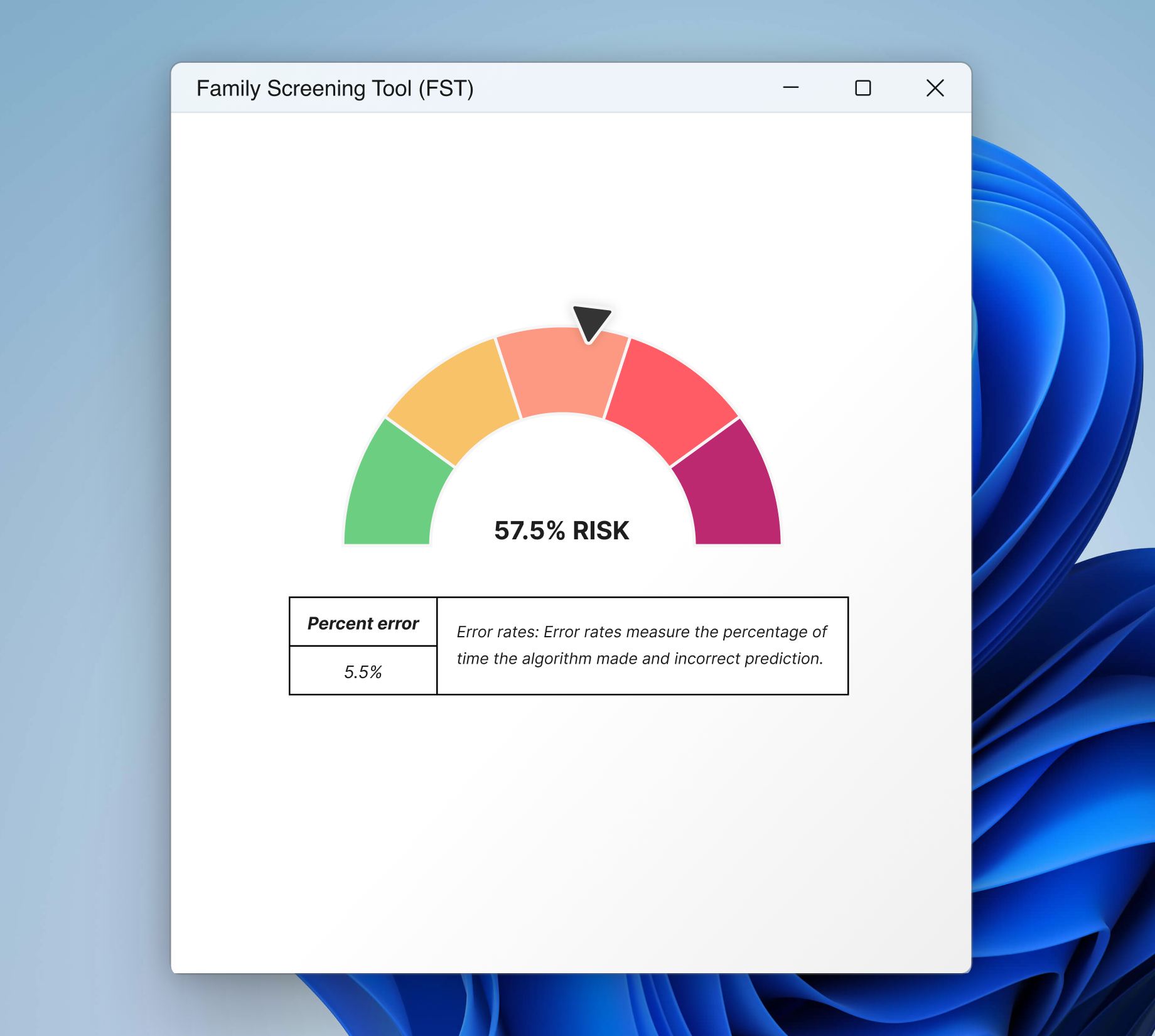
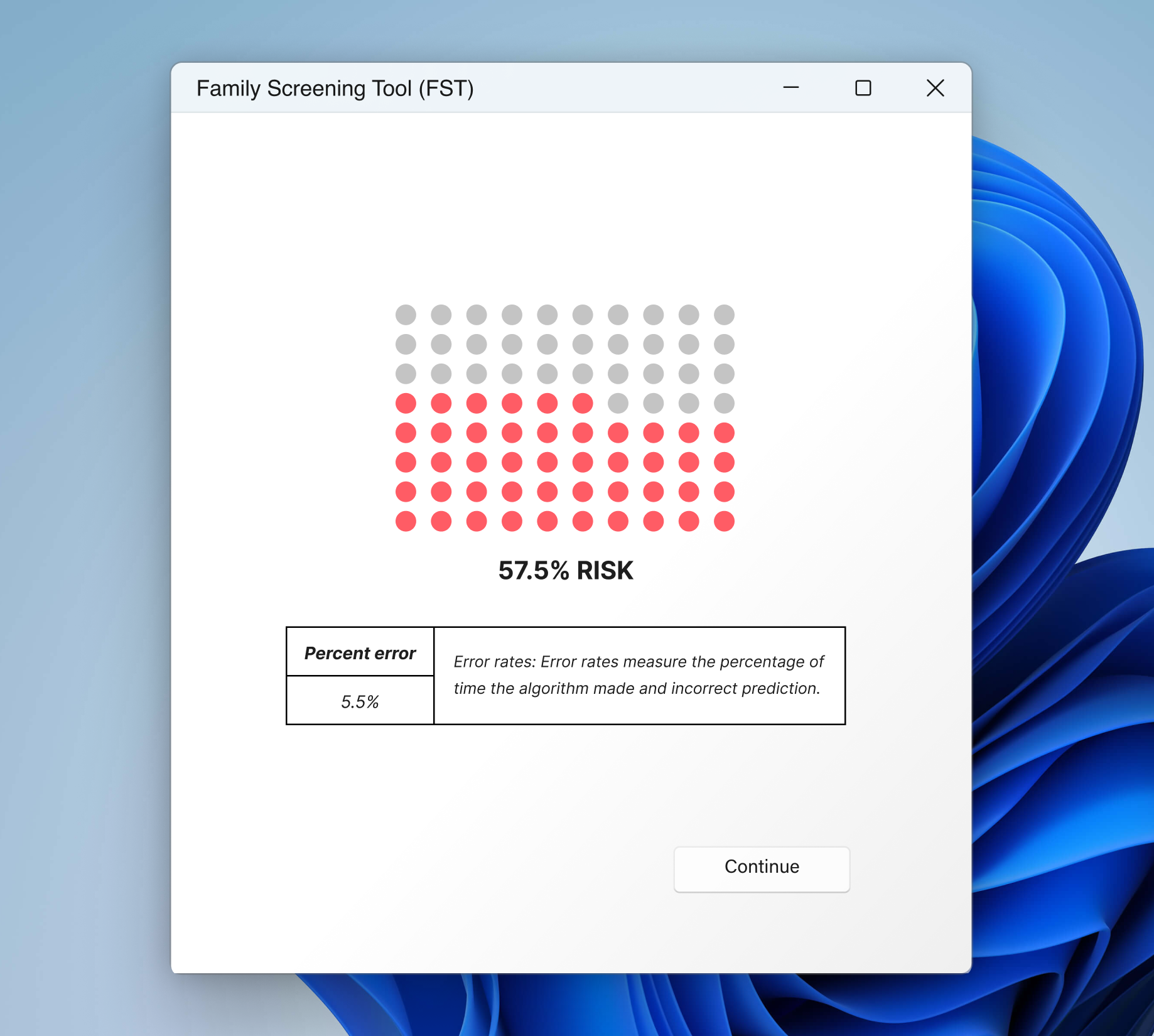
<p>Using the Allegheny Family Screening Tool (AFST)—a system that helps child welfare workers assess family risk—I conducted a pilot between-subjects study with 225 participants to test whether graphical risk prediction widgets influence user decisions. Each participant reviewed a case scenario typical of AFST use and was randomly assigned one of four widget designs: two icon array variants (see Figure 1) and two gauge scale variants (see Figure 2). Participants then classified the case into low, medium, or high risk categories and completed a satisfaction survey about the system.</p>

<p><a href="https://verrynatalia.github.io/ms-projects/capstone-project/Assignment_05_v3.pdf" target="_blank">Read the full report</a></p>

<h2 id="hypotheses">Hypotheses</h2>
<ul>
  <li>H₀: The graphical risk prediction widget does not influence the user’s decision</li>
  <li>H₁: The graphical risk prediction widget influences the user’s decision</li>
</ul>

<h2 id="findings-and-limitations">Findings and limitations</h2>
<p>The results showed no statistically significant differences in risk classifications across widget types. However, challenges in recruiting participants with social work backgrounds prevent drawing definitive conclusions about real-world applicability. Despite these limitations, the satisfaction survey revealed an intriguing pattern: participants assigned icon arrays reported higher trust in the tool’s prediction accuracy compared to those who used gauge scales.</p>

<h2 id="future-work">Future Work</h2>
<p>Reducing the design variants to two and conducting contextual interviews with experienced social workers and child protection professionals would strengthen this research. Additionally, examining risk prediction interfaces in other domains could identify design principles that generalize across decision support systems.</p>

<p><img src="/ms-projects/capstone-project/Gauge%20Percent-1.png" alt="" style="width: 70%;" /></p>
<center>Figure 1. Gauge scale with percentage</center>
<p><br /></p>

<p><img src="/ms-projects/capstone-project/Icon%20Percent-1.png" alt="" style="width: 70%;" /></p>
<center>Figure 2. Icon array with percentage</center>
<p><br /></p>

<p><em>Last updated: September 29, 2025</em></p>]]></content><author><name>Natalia Echeverry</name></author><category term="projects &amp; work samples" /><summary type="html"><![CDATA[Research Question and Context How should risk prediction systems present information to decision-makers with limited quantitative skills? I explored this question during Spring 2024 under Dr. Robert Kostin’s direction, focusing on interface design that minimizes cognitive biases and interpretation errors in human-AI interaction.]]></summary></entry><entry><title type="html">CMU LearnLab: Addressing Automation Bias - Short Course Overview and Lesson Plan</title><link href="https://verrynatalia.github.io/writing%20&%20presentations/automation-bias-training/" rel="alternate" type="text/html" title="CMU LearnLab: Addressing Automation Bias - Short Course Overview and Lesson Plan" /><published>2024-08-02T12:30:00+00:00</published><updated>2024-08-02T12:30:00+00:00</updated><id>https://verrynatalia.github.io/writing%20&amp;%20presentations/automation-bias-training</id><content type="html" xml:base="https://verrynatalia.github.io/writing%20&amp;%20presentations/automation-bias-training/"><![CDATA[<p><a href="https://verrynatalia.github.io/ai-and-edtech/automation-bias-training/Natalia_Firehose_Presentation.pdf" target="_blank">Course Overview and Lesson Plan (Firehose Presentation)</a></p>]]></content><author><name>Natalia Echeverry</name></author><category term="writing &amp; presentations" /><summary type="html"><![CDATA[Course Overview and Lesson Plan (Firehose Presentation)]]></summary></entry><entry><title type="html">CMU AI Literacy Hackathon: Using GenAI in Research</title><link href="https://verrynatalia.github.io/writing%20&%20presentations/AI-hackaton/" rel="alternate" type="text/html" title="CMU AI Literacy Hackathon: Using GenAI in Research" /><published>2024-04-03T11:00:00+00:00</published><updated>2024-04-03T11:00:00+00:00</updated><id>https://verrynatalia.github.io/writing%20&amp;%20presentations/AI-hackaton</id><content type="html" xml:base="https://verrynatalia.github.io/writing%20&amp;%20presentations/AI-hackaton/"><![CDATA[<p><a href="https://osf.io/whg2n">Using GenAI to Assist the Research Process: Do’s and Don’ts (OER)</a><a href="https://osf.io/gjhk2" target="_blank">(PDF)</a></p>

<p><a href="https://www.library.cmu.edu/about/news/2024-04/ai-literacy-hackathon" target="_blank">AI Literacy Resource Hackathon</a>.</p>]]></content><author><name>Natalia Echeverry</name></author><category term="writing &amp; presentations" /><summary type="html"><![CDATA[Using GenAI to Assist the Research Process: Do’s and Don’ts (OER)(PDF)]]></summary></entry><entry><title type="html">Tableau Story: Tales of Venice</title><link href="https://verrynatalia.github.io/projects%20&%20work%20samples/tales-of-venice/" rel="alternate" type="text/html" title="Tableau Story: Tales of Venice" /><published>2023-02-05T10:00:00+00:00</published><updated>2023-02-05T10:00:00+00:00</updated><id>https://verrynatalia.github.io/projects%20&amp;%20work%20samples/tales-of-venice</id><content type="html" xml:base="https://verrynatalia.github.io/projects%20&amp;%20work%20samples/tales-of-venice/"><![CDATA[<p><a href="https://public.tableau.com/app/profile/natalia.echeverry4584/viz/AirbnbinVenice/TalesofVeniceHistoricalCenter" target="_blank">Tales of Venice</a></p>]]></content><author><name>Natalia Echeverry</name></author><category term="projects &amp; work samples" /><summary type="html"><![CDATA[Tales of Venice]]></summary></entry><entry><title type="html">UNICEF: Action to End Child Sexual Exploitation and Abuse (Available in English, Spanish, French)</title><link href="https://verrynatalia.github.io/projects%20&%20work%20samples/action-to-end-abuse/" rel="alternate" type="text/html" title="UNICEF: Action to End Child Sexual Exploitation and Abuse (Available in English, Spanish, French)" /><published>2022-11-30T17:00:00+00:00</published><updated>2022-11-30T17:00:00+00:00</updated><id>https://verrynatalia.github.io/projects%20&amp;%20work%20samples/action-to-end-abuse</id><content type="html" xml:base="https://verrynatalia.github.io/projects%20&amp;%20work%20samples/action-to-end-abuse/"><![CDATA[<p><a href="https://agora.unicef.org/course/info.php?id=33811" target="_blank">“Action to End Child Sexual Exploitation and Abuse” 
course</a></p>]]></content><author><name>Natalia Echeverry</name></author><category term="projects &amp; work samples" /><summary type="html"><![CDATA[“Action to End Child Sexual Exploitation and Abuse” course]]></summary></entry></feed>